What factors affect the service life of stainless steel mesh belts
Mar 01, 2023
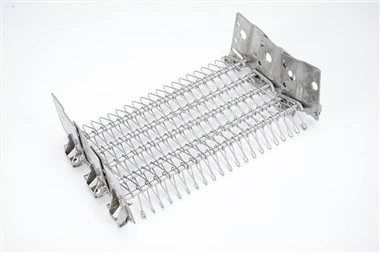
Stainless steel mesh belt has special functions such as flat mesh surface, high strength and hardness, strong corrosion resistance, high tensile strength, good breathability, and not easy to deform. In addition, stainless steel mesh belt has the durability and other special functions. It is an essential main component in automatic devices and modern automatic assembly lines in various industries. However, in practical applications, many factors directly affect the service life of stainless steel mesh belt. Below, we will analyze the following.
1. Oxygen: Free radical chain reaction occurs between oxygen and stainless steel molecules, resulting in molecular chain breakage or excessive cross-linking, leading to changes in the properties of stainless steel. Oxidation is one of the important reasons for aging of stainless steel mesh belts.
2. Ozone: The chemical activity of ozone is much higher than that of oxygen, and its destructive power is much greater than that of oxygen. Oxygen also destroys molecular chains, but the effect of ozone on stainless steel mesh belts varies depending on whether stainless steel is deformed. When stainless steel (mainly unsaturated stainless steel) is deformed, cracks appear perpendicular to the stress direction, which is called "ozone cracking"; When applied to deformed stainless steel mesh belts, the surface only forms an oxide film and does not crack.
3. Temperature: Increasing the temperature can cause thermal cracking or thermal crosslinking of stainless steel mesh belts. But the basic function of heat is activation. Increasing the oxygen diffusion rate and activating the oxidation reaction can accelerate the oxidation reaction of stainless steel mesh belts, which is a common aging phenomenon - thermal oxygen aging.
4. Light effect: The shorter the light wave, the greater the energy. What destroys the stainless steel mesh belt is the higher energy ultraviolet rays. Ultraviolet light can not only directly cause molecular chain breakage and cross-linking of stainless steel mesh belts, but also generate free radicals due to the absorption of light energy, triggering and accelerating the oxidation chain reaction process. Ultraviolet light acts as a heating agent. Another characteristic of light action (unlike heat action) is that it mainly occurs on the surface of oak. A network of cracks on both sides of a sample with a high glue content can occur, known as "optical outer layer cracks.".